Thursday, January 08, 2015

I Knew Sunanda. But I Can't Say If She Killed Herself by SUHEL SETH.

(Suhel Seth is Managing Partner of Counselage: India's only strategic brand advisory.)
With due apologies to Shakespeare, there is obviously something rotten in the state of India. 

We have invented the art of public trials with allegations which are hurtful and insensitive and made a mockery out of every institution that is supposed to be righteous and moral.

When Sunanda Tharoor was declared dead on the night of January 17, 2014, even she wouldn't have imagined how her death would spark indignation and rage, conjecture and mystique, but rarely empathy and grief. The fact that the investigations into her death were more of a public spectacle rather than getting down to the truth is what saddens me. 

Let me make full disclosure: Sunanda was a very dear friend of mine and I knew her long before either she met Shashi Tharoor or before I knew Shashi. I became a friend of Shashi's because I knew Sunanda. Did I know Sunanda so well that I could jump to conclusions about her vivacity or her joi-de-vivre? I guess not. And no one does. I am amazed at the utterances of her so-called 'friends' who are near certain that she could have never taken her own life. I, for one, will not jump to such conclusions. 

All three possibilities are up in the air. She could have knowingly taken her own life; she could have accidentally overdosed on whatever she is supposed to have been taking; or someone could have killed her. 

The fact that on the afternoon of January 6, 2015, almost a year after Sunanda's passing on, the Delhi Police Commissioner, a fine cop at that, says in a press statement that hers was an unnatural death should suffice. The Commissioner went on to add that samples would be sent abroad perhaps for better results and I guess neutrality is something we should consider responsibly. But then what erupted on social media and then in the evening on national television is distressing. Many on both platforms were vultures and nothing less. People forgot that in the wake of her death she left behind a crestfallen husband, an orphaned son and a family immersed in grief. 

But then do we care about all of this? We don't. Because we have become a nation that lives in the moment. We live to make other people fall. The alacrity with which Shashi Tharoor was condemned was initially amusing but later very anguishing; add to that the grand-standing by the two national political parties  and this whole trial-by-media comes across as sordid and pernicious.

We cannot hope to be a civilized society if such is the brand of our behaviour. We cannot hope for the rule of law to prevail if television anchors become cops and judge every evening. We cannot hope for fairness in justice if investigations take so long that they lose both steam and credibility and this is what happened with Sunanda's death.

It is not my place to conjecture how she died. That is for the police and the courts to rule. But it is my place to sound an alarm at our societal norms. We did that more recently in the Aarushi Talwar murder case and we are doing it now. We are slowly morphing into a country that operates on intolerance coupled with unbridled rage, both of which have no grounds to exist in a society that wants to progress on the back of dignity and equality. Something will give way.

In many ways, just as when she lived, in her death, Sunanda Tharoor is teaching us one vital lesson. Being human is far more important than being judgmental. And I wish for her sake and for the sake of this fine country, we learn the lesson and learn it well.

Sometimes the dead teach us how to live. And I hope we learn this lesson with equanimity and humility.

Monday, January 05, 2015

The Naked Ape by DESMOND MORRIS.

Naked Ape was published in 1967. The book has shocked many people. It became a controversy. Every word desmond wrote became the subject of heated debate. In some parts Naked Ape book was banned, confiscated & burned by the church.

Desmond Morris reminds us that man is relative to apes. He highlights some surprising facts
that are raising quite a few eyebrows in the scientific and non-scientific world.

  • Homo sapiens not only has the biggest brain of all primates but also the largest penis, and is "the sexiest primate alive"
  • our fleshy ear-lobes, unique to humans, are erogenous zones (any area of the body especially sensitive to sexual stimulation) that have been known to provoke orgasm in both males and females,
  • the more rounded shape of human breasts means they are primarily a sexual signalling device rather than simply a milk machine

He sheds new light on our own behaviour and society, describing our ways of " feeding, sleeping, fighting, mating and rearing young".

Morris explains each male, as the head of a family, became involved in defending his own individual home base inside the general colony base. So for us there are three forms of aggression, instead of the usual one or two says morris in his book in the chapter of "Fighting" ' page 101'. 

How does the aggression work? What are the patterns of behaviour  involved? How do we intimidate one another? We must look again at the other animals. When a mammal becomes aggressively aroused a number of basic physiological changes occur within its body. The whole machine has to gear itself up for action, by means of the autonomic nervous system. This system consists of two opposing and counter-balancing sub-systems - the sympathetic and the parasympathetic. The former is the one that is concerned with preparing the body for violent activity. The latter has the task of preserving and restoring bodily reserves. The former says, ' You are stripped for action, get moving'; 'Take it easy, relax and conserve your strength.' Under normal circumstances the body listens to both these voices and maintains a happy balance between them, but when strong aggression is aroused it listens only to the sympathetic system. When this is activated, adrenalin pours into the blood and the whole circulatory system is profoundly affected. The heart beats faster and blood is transferred from the skin and viscera to the muscles and brain. There is an increase in the blood pressure. The rate of production of red blood corpuscles is rapidly stepped up. There is a reduction of time taken for blood to coagulate. In addition there is a cessation in the processes of digesting and storing food. Salivation is restrained. Movements of the stomach, the secretion of gastric juices, and the peristaltic movements of the intestines are all inhibited. Also, the rectum and bladder do not empty as esily as under normal conditons. Stored carbohydrate is rushed out of the liver and floods the blood with sugar. There is a massive increase in respiratory activity. Breathing becomes quicker and deeper. The temperature regulating mechanisms are activated. The hair stands on end and there is profuse sweating. All these changes assist in preparing the animal for battle.  

Thursday, December 04, 2014

Ritual slaughters thousands of animals

Death and the goddess: The world's biggest ritual slaughter

Kathmandu, Nepal (CNN) -- Motilal Kushwaha had promised the Hindu goddess Gadhimai that he would offer her a male goat if one of his children found a job.
Last year his son was successful -- and on Saturday he was one of tens of thousands of people killing the animals at the temple of Gadhimai in southern Nepal as part of the biggest religious mass slaughter in the world.
Ritual slaughters thousands of animals
"From my village everyone has made a vow [to offer animals]," says Kushwaha from Bariyarpur, a community in Bara district about 60 miles south of Kathmandu. Some, he explains, are glad they have got a son or a daughter, others that a different form of good fortune has befallen them.
The ritual sacrifice of goats, buffaloes and roosters in temples and at home is widespread in Nepal where 80 percent of the population are Hindu.
Some five million people from adjoining districts -- and also from the bordering Indian states of Bihar and Uttar Pradesh -- will attend the festival, according to local authorities, although only two days are dedicated to the sacrificial ritual itself.
The slaughter follows a set pattern: on Friday male water buffalo calves are killed while on Saturday attentions switches to goats.
Officials estimate that up to 10,000 buffalo calves and 150,000 goats will be offered to Gadhimai -- the goddess of power -- during the ritual. Watch a CNNi report on the ritual
But these numbers will be much lower than those of 2009, the last time the five-yearly Gadhimai festival took place, thanks to advocacy efforts by animal rights activists. In that year nearly 20,000 buffalo calves were killed, according to temple officials and more than 200,000 goats were slaughtered.
"We object to the cruelty with which animals are treated," says Pramada Shah of Animal Welfare Network Nepal. "There is random hacking of animals in open space. Not all animals have their heads chopped off. Some take up to 40 minutes to die."
The participants -- who hack the animals in an enclosed arena with large knives -- are licensed by the Gadhimai Festival Management and Development Committee. This year about 400 people will kill animals, according to Kushwaha, who is also the committee's secretary.
The animals not only suffer while they are being killed: they are also transported over long distances on foot. "By the time they get to the festival venue they are half dead," says Shah. "They are kept two or three days without food after they are brought here."
Activists have gone to the courts in Nepal and India to halt the sacrifices. Last month Nepal's Supreme Court did not stop the animal sacrifices but ruled that existing laws have to be followed.
"If the existing laws are implemented there would be no ritual sacrifices," says Shambhu Thapa, the lawyer who filed the case, explaining that only animals killed in a slaughterhouse are fit to be eaten. (The meat of the sacrificed animal is usually eaten, or given away to meat-eaters for their consumption.)
Courts in India also directed the Indian government not to control the unnecessary export of animals to Nepal. The Indian authorities, for their part, had directed security agencies and state governments to check the flow of livestock to the neighboring country. In a letter to the Uttar Pradesh government seen by CNN, India's Home Ministry estimated in September as many as 90,000 buffaloes would be "illegally" transported to Nepal for the festival.
But animals continue to flow into Nepal through the porous and open border. "The border cannot be controlled and corruption is endemic," says Shah.
Nepalese authorities are also reluctant to stop the ritual sacrifice. "We cannot do this," explains chief district officer Dulal. "We cannot speak against it. This is something to do with culture."
Kushwaha adds: "If we tell the people to stop the sacrifices, they will come to kill us. This is something related to people's religion and faith." Hindu religion does not support the ritual sacrifice of animals, says Shah. "We consulted religious priests on the matter," she says.
Activists in Gadhimai, meanwhile, are confident that there will be changes in people's attitudes.
Uttimlal Chaurasiya, from Bariyarpur, claims that some 40 percent of the women in the village have said that they will not sacrifice animals. Three years ago he started a campaign showing videos of cruelty to animals at the festival to villagers. While awareness is being raised at a local level, he believes binding laws are still needed to stop the sacrifices.
"All living creatures are equal in the eyes of god," he says. "Instead of animals we can offer gourds, pumpkins, coconuts and sweets to the goddess."
The festival management committee cannot stop the animal sacrifices, but if the government asks the committee can discuss the issue, says Kushwaha.
Shah and other activists had been working with the government since the last festival in 2009 to stop the sacrifices but although there was some progress, a government decision was not reached.
Meanwhile, on Friday morning tens of thousands of people gathered around the temple in Bara district, southern Nepal, waiting for the sacrificial ritual to begin. "People seem to be in a merry mood and look like they have been waiting for this moment for ages," says Niraj Gautam, an animal welfare activist, from Bariyarpur. "But it is a sad day for us."
He estimates 6,000 to 8,000 water buffaloes will be randomly hacked, not necessarily by having their heads chopped off.

"Any part of the body can be cut," he says. "Last time round we saw buffalo walking with their head hanging."

Myths made reality, bizarre claims made for ancient India's achievements

India conducted a nuclear test centuries ago; cow urine can cure diabetes and ancient India was adept at genetics and plastic surgery. These and more such incredible achievements datelined ancient India have come from votaries of Hindu culture.
If people with scientific temper are reaching boiling point, in the absence of technology to go back in time to ancient India for verification trips, little noise is being heard from their quarters.
Here is a sample of what is being claimed as 'Indian science'.
Nuking reason
http://www.hindustantimes.com/Images/popup/2014/12/pokhriyal.jpg
File photo of Ramesh Pokhriyal Nishank. (AFP Photo)
The world acknowledges India has conducted two sets nuclear tests: in 1974 and 1998. Ramesh Pokhriyal Nishank, BJP MP from Haridwar and former Uttarakhand chief minister, disagrees. "Today we are talking about nuclear tests. Lakhs of years ago, Sage Kanad had conducted a nuclear test. Our knowledge and science do not lack anything," Nishank told Parliament. Nishank also batted for astrology, saying it is the topmost science in the world. He said our ancient astrologers dwarfed all other sciences.
Cow urine therapy
Promoting cow urine is a priority for the Rashtriya Swayamsevak Sangh (RSS), seen as the BJP's spiritual and ideological guide. It was reported in May that Madhya Pradesh-based promoters of medicines produced using cow urine or 'gau-mutra' hope that a BJP government at the Centre will help their business.
The RSS is keen on promoting a soft drink made from cow's urine, mixed with products such as aloe vera and gooseberry to fight diseases. "Cow urine offers a cure for around 70 to 80 incurable diseases like diabetes. All are curable by cow urine," said Om Prakash, head of the RSS's cow protection department, in 2009.
Faith in astrology
http://www.hindustantimes.com/Images/popup/2014/12/irani.jpgFile photo of Smriti Irani. (Raj K Raj/HT Photo)
Union HRD Minister Smriti Irani will one day be the country's president: that prediction came from the BJP politician's astrologer in Bhilwara, Rajasthan. "She will become president... in five years," the astrologer told reporters last month after Irani's visit. Irani was asked about her faith in astrology when she is in charge of education. "What I am doing in my personal life is not the responsibility of media to report until and unless it affects my duties," she replied.
Karna a product of genetic engineering
Prime Minister Narendra Modi, speaking at the inauguration of a hospital in Mumbai in October, equated birth of Mahabharata's Karna to genetic engineering. He said, "We can feel proud of what our country achieved in medical science at one point of time. We all read about Karna in Mahabharata. If we think a little more, we realise that Mahabharata says Karna was not born from his mother's womb. This means that genetic science was present at that time. That is why Karna could be born outside his mother's womb."
Ganesha plastic surgery

At the same event, Modi also said, "We worship Lord Ganesha. There must have been some plastic surgeon at that time who got an elephant's head on the body of a human being and began the practice of plastic surgery."


Dinanath Batra claims stem cell research invented by an Indian
In his book Tejomay Bharat, Dinanath Batra, convenor of Shiksha Bachao Andolan Samiti, claimed stem cell research was invented by an Indian, Dr Ganpat Matapurkar, who was inspired by the Mahabharata.
Sanal Edamaruku, president of Indian Rationalist Association, said people need to differentiate between "myth and reality. "Myths are there in all parts of the world and in all cultures; if we can't differentiate myth and reality, something is seriously wrong," said Edamaruku in an e-mail from Helsinki.
Article 51A of the Constitution says Indian citizens have the duty to 'develop the scientific temper, humanism and the spirit of inquiry and reform'. It's an article that our elected representatives must remember--they are sworn to uphold the Constitution.     
http://www.hindustantimes.com/Images/popup/2014/12/Dinanath-Batra.jpg
File photo of Dinanath Batra. (LiveMint Photo)


Thursday, November 27, 2014

Ushering India back to a vedic future.

Ushering India back to a vedic future

Modi is a modern techie, but is he a moderniser? He cannot be as long as he and his govt propagate back-to-the-scriptures science
Shekhar Gupta  November 20, 2014 | UPDATED 14:01 IST
 
Is Narendra Modi a moderniser or a traditionalist? Is he forward-looking or trapped in the past, however glorious? Does he aspire to lead India into a brilliant new future, or bring back "Sone ki Chidiya" (the golden sparrow) fantasy? I know the answer to all three questions from his many followers: he is a forward-looking moderniser who wants to lead India into a great future. He loves technology, he celebrates science. He took the cue on using social media for political campaigning from Obama and improved on it greatly. He takes selfies with fellow heads of state (Australian Prime Minister Tony Abbott in this case) and tweets them, and when a glamorous, star struck Bollywood leading lady, towering a foot over him, bends over his shoulder to take a selfie he looks back in debonair style to ask, "Got it?" In more ways than one he comes across as India's most modern prime minister since Rajiv Gandhi. At which point, we need to ask yet another question. Will his government reflect his own modernism or RSS nostalgia?
The two cannot go together. Modern thinking is about science, technology, curiosity to discover what hasn't been discovered yet and humility to accept that the human race has to reach new frontiers, that what we may know yet is a fraction of what we don't. The traditionalist RSS view, on the other hand, is that whatever mankind may be hoping to imagine, discover or design in the future had already been perfected in Vedic times. All you need to do in that case is a close but open-minded reading of the Vedas, Puranas and Upanishads. We had lost it because the Hindu empire and heritage suffered with the decline of the Gupta and Mauryan dynasties and with the arrival of invaders from the west, leading to subjugation by Muslims and then Christians. Modi's rise, therefore, is India's first chance in a millennium to leapfrog backwards and connect with that past. Or, to put it more rudely, set the clock and calendar back.
This is a serious issue to raise at a point when the new government seems to be settling down. A crucial Parliament session is beginning. It needs to be raised because it is a key mainstream issue and not a mere distraction from the entertaining fringe of true believers with degrees from Dina Nath Batra Vidyapeeth.
'We are a country steeped in superstition. Our missile scientists perform pujas and break coconuts before test-firing a new Agni. Our space scientists take a model of Mangalyaan to Tirupati.'It will be delusional to dismiss Dina Nath Batra as a lone maverick and merely the slayer of Wendy Doniger's scholarship. He represents a new force in our political and intellectual discourse even if it is a force of old think. His power over the BJP's HRD ministry is now evident. This week a new precedent was set in New Delhi as German Ambassador Michael Steiner called on Batra, reasoning with him to calm down on his opposition to German language classes in schools. But you can see Sanskrit winning, in spite of all his diplomatic charm. At a moment like this, a gentle intervention was needed from a modernising prime minister. Something like, why should it be Sanskrit versus German? Sanskrit is a wonderful classical language and should be made attractive to all (and liberated from its pandit ji stereotype), and why just German, Indians must have a choice of many important foreign languages, French, Spanish and even Mandarin included. This is a globalised world, a globalising India and Modi is our most outgoing prime minister since Nehru. This is no time to go back to the depths of the old trenches of cultural and linguistic insecurities. This young India wants to go out and embrace the world, just as Modi does with his global peers. (Note meanwhile that the government of Haryana has already decided to seek Batra's advice on "modernising" its education system.)
This argument is not about an individual, but about a state of mind. Where you confuse rationality with tradition, curiosity with scripture. It gets more complicated. In 2001 I was among the many senior journalists on Atal Bihari Vajpayee's entourage to Iran. And it was every bit worthwhile, particularly as we all reached Persepolis, the ancient city wrecked by Alexander the Great. As we surveyed the ruins, an eminent RSS intellectual in the group started "educating" all of us on "history". He said, see, what a terrible man Alexander was. This is precisely what he wanted to do to India. But he was defeated by a minor Hindu king, Porus, whose real name was Paurush (manhood). He was fleeing India in fright, his army disintegrated, and died a forlorn man. At which point I tried to intervene saying that history was quite different, but was ignored. My much wiser friend, and strategic affairs pundit, C. Raja Mohan tapped me on the shoulder and said, don't argue with them, they confuse history with faith. His words come back to me often these days.
Because history has been a political and ideological football in India for long, you can probably understand why RSS intellectuals now want to get even with those of the Left, who reigned all these decades and brought in their own loaded, secular distortions. History can still survive robust disagreements and debate, even if it is often as irrational as arguing that the Taj Mahal was a Hindu temple. But a much bigger challenge arises when not just history, but even science is confused with faith. Which is the provocation for this week's National Interest.
Last week Home Minister Rajnath Singh nearly stole the headlines from Modi in Australia with his statement (in a speech on Hindi Divas) that physicist Werner Heisenberg had learnt his famed Uncertainty Principle from the Vedas. (It is a different matter that some over-enthusiastic spin-master in his ministry had not heard of Heisenberg and issued a press release calling it Eisenhower's Uncertainty Principle instead.) This is a tricky pattern of thinking.
It fits in with the larger, enduring mythology that anything being discovered by the Western world now had been developed in Vedic times already. Lord Ram returned with Sita and Lakshman in Pushpak Viman from Lanka to Ayodhya, so see, we had airplanes then. You talk about ICBMs with multiple warheads, Patriots which intercept incoming missiles, Strategic Defence Initiative, what were the "Shakti-bans" that Ram and Ravan traded routinely in the battle for Lanka? Or Arjun with his awful Kaurav cousins? Ramanand Sagar worked so hard to remind you of this "heritage" in his endless tele-serials. Never mind that today we can't even put together a reliable assault rifle for our troops.
Nobody is denying that our scriptures (Vedas, Upanishads) and epics (Ramayana, Mahabharata) are truly ancient, and also brilliantly capacious in their imagination and wisdom. It is likely that we imagined mechanised flight much earlier while our intellectual rivals, the Greeks and Romans, were still fitting giant bird wings to human forms, from Icarus to Phoenix. Of course Aryabhata and disciples visualised, debated and documented many astronomical facts and ideas for which wise Europeans were burnt at the stake or poisoned hundreds of years later. Possibly, someone even imagined plastic surgery, animal to human organ transplants, stem cell research, surrogate motherhood. But to say we already "had" all of these is not just funny, it is dangerous. We are a country steeped in tradition and superstition. Our missile scientists perform pujas and break coconuts before test-firing a new Agni. Our space scientists take a model of Mangalyaan to Tirupati to be blessed by Lord Balaji before the launch. If you also tell them they are simply replicating, if not reverse-engineering, what we already had millennia ago, it will be dangerous. Because many of them may not even contest it.
This is Modi's big challenge going ahead. He does have a modern, even a techie mind. But he and the ideological/cultural juggernaut propelling him also have delusions of ancient grandeur. The two, scriptural mythology and quest for modern new discovery, cannot co-exist. If there is one leaf Modi needs to take from Nehru's book, it is scientific rationalism.
MEANWHILE in Pune, at the feet of Aryabhata: I had the privilege last week to spend a few hours with Prof Jayant Narlikar, by far the most eminent Indian astrophysicist today and co-author of the Hoyle-Narlikar theory questioning Big Bang. He had built the Inter-University Centre for Astronomy and Astrophysics (IUCAA) at Pune University and his central garden has large statues of the greatest of all times: Newton, Einstein, Galileo and, most certainly, Aryabhata.
Narlikar is also among India's bravest and most thick-skinned rationalists. Even at 76, his eyes light up when you mention superstition and ancient beliefs. Nothing irritates him more than people confusing his science with astrology. The Pune phone book usually lists IUCAA as a centre for astrology.
To make a point, he says, he collected a couple of hundred horoscopes of the most brilliant student achievers and mentally-challenged children and gave them to India's most eminent astrologers. None was able to pick the right ones.
Narlikar says astrology is bunkum and that to call it Vedic is a travesty. In Vedic tradition, he says, there was no astrology, no Mangal ruining marriages, no Brahaspati spreading beneficence and no Shani messing it all up unless you presented the tribute of mustard oil and cash every Saturday. All of this, he says, came from Greece. Alexander had also brought along many "wise" men with his army, some stayed back and spread astrology, to which our ancestors, Hindu or not, Porus or Paurush, took so warmly. So whatever else, let's at least not blame our Vedas for the faults in our stars.
Follow the writer on Twitter @ShekharGupta


Humsafar A journey after the Marriage.


"Humsafar" is a Pakistani TV serial with a good script and dialogues aired in Indian
Television channel two years back (2011-2012). The story explores the trials and tribulations
of the married couple. 'Humsafar' which means companion is about their journey after the
marriage.


Monday, November 24, 2014

From Outlookindia

AP
The eternal amorist Mohan Bhagwat at an RSS meet in Bangalore
ESSAY: HINDUTVA
The Morality Tale That The Mahabharata Just Isn’t
Its epic transgressions surely cannot be the underpinning of the Sangh parivar’s Hindutva
The new chairperson of the Indian Council of Historical Research (appointed by the BJP-led government), Yellapragada Sudershan Rao, has promised to push research projects to rewrite ancient history based on the stories of the Ramayana and the Mahabharata. According to him, they are truthful accounts of historical events. But he should be careful when choosing the epics.
The stories of the Mahabharata, for instance, are often at odds with the Hindutva that the BJP government and its parent Sangh parivar preach. Although the votaries of Hindutva worship the epic’s heroes and heroines, the messages that most of the latter impart may not be suitable for the present government’s programme to educate our people in the “moral and cultural values” that they want to uphold in the name of Hindutva. In fact, the deities and mortals described in the eighteen volumes of this hefty tome had never once been designated by the term ‘Hindu’. The Mahabharata may turn out to be a rather uncomfortable quarry for the BJP ministers and Sangh parivar historians to dig up models to suit a Hindu-specific Indian ideal of morality and culture.
The just-replaced health minister Harsh Vardhan (a medical practitioner!) played a major role in this effort to create a behavioural pattern based on a supposedly “Indian moral culture”. In an interview to the New York Times, he is reported to have recommended abstinence from “pre-marital and extra-marital sex” as a better means of avoiding aids instead of using condoms, since such abstinence is “a part of Indian culture”. In yet another effort to reform the sartorial preferences of Indian women, a BJP minister of Goa, Sudhir Davalkar, warned: “Scantily dressed girls (do) not fit in our culture.” Plans are also afoot to revive ‘Indian culture’ by RSS institute Bharatiya Itihas Sankalan Samiti which has laid down guidelines for writing history from our puranas, to cleanse the current history textbooks of “corrupt Western cultural influences”.


The Mahabharata’s heroines did not conform to the Hindu ideal of female chastity our ministers want our women to follow.
 
 
But these views and norms about sexual practices and female behaviour and attire that these venerable gentlemen are propagating and laying down as the one—and only—‘Indian culture’ sanctified by their Hindu religious tradition were flouted by the heroes and heroines of the Mahabharata itself. Most of the heroines did not set much store by the Hindu ideal of female chastity that our ministers would want our women to follow. Going by the explicit description of the beautiful contours of their bodies (quite visible behind their dress) that we find in the epic, they beat hollow the hip-hugging jeans-clad women that the Sangh parivar’s moral guardians are objecting to. As for the heroes of the Mahabharata, they merrily indulged in pre-marital and extra-marital relationships. And let us not forget that they and their children, who were born out of wedlock, were elevated to positions of superheroes.
Birth of the ancestors of Kurus and Pandavas: Without pre-marital and extra-marital sex, which Dr Harsh Vardhan and his party leaders blame as the main cause of our problems, they would not have had their heroes like Veda Vyasa (who wrote the epic), and the sons that he bred through adulterous relationships (Dhritarashtra, Pandu and Vidura), and his grandsons (the five Pandavas). Let us listen for instance to the story of the birth of Veda Vyasa, as described in the Adi Parva of Mahabharata: One day the great sage Parashara, in the course of his pilgrimage, arrived on the shores of the Yamuna river and saw an extraordinarily beautiful woman with a charming smile on her lips, seeing whom he was affected by the excruciating desire of making love to her. The woman happened to be Matsyagandha (her name meaning ‘smelling of fish’, since she was the adopted daughter of a fisherman family), who used to ferry passengers in her boat across the river. When Parashara approached her with his desire, she expressed her inability to immediately satisfy him, drawing his attention to the large number of rishis (sages) waiting on both banks of the river for her to carry them across. Parashara immediately created a fog that immersed the area in darkness—so that the rishis could not see what he planned to do. Although impressed by Par­ashara’s miracle, Matsyagandha pleaded: “But I shall lose my virginity if I satisfy your desire. How can I then go back to my home, and live in society?” Parashara said: “If you satisfy me, I shall give you whatever you pray for...and res­tore your virginity.” Matsyagandha prayed: “Please let my body exude a sweet smell.” Having been granted that req­uest, she agreed to sleep with Parashara—and in due course, gave birth to a son who came to be known as Krishna Dwaipayana (meaning dark-skinned and born on an isl­and). Vyasa left home to be an ascetic, but reassured his mot­her that he would come back to her whenever she needed him.

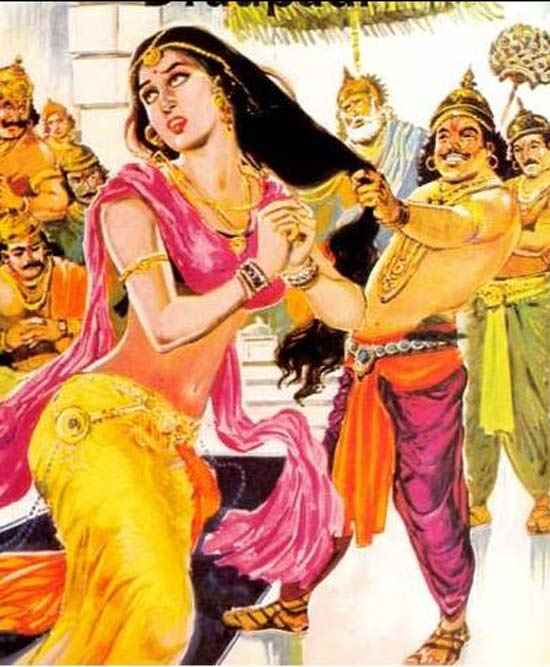
The chirharan Was putting Draupadi on stakes any lesser sin?


It was through Kshetraja or the practice of producing children through extra-marital recourse that Pandavas were born.
 
 
Sometime later, his mother (now known as Satyavati, her body “sweet-scented” and her “virginity restored”—thanks to Parashar’s blessings) got married to a king called Shantanu. Through him, she gave birth to two sons—Chitrangad and Vichitravirya. After Shantanu’s death, Chitrangad was killed in a battle, and Vichitravirya ascended the throne. He married two sisters—Ambika and Ambalika (both daughters of a king). TheAdi Parva describes how Vichitravirya failed to produce any children, even “after spending seven years with the two queens in continuous vihar (amorous frolic), (following which) he fell victim to tuberculosis in his youth,” and died despite sincere efforts by his friends and doctors. The problem started now. How were the two childless queens expected to carry on the dynasty? Their mother-in-law Satyavati first requested her stepson Bhishma (her late husband Shantanu’s son by his first marriage) to impregnate the two young widows. When he refused, she summoned her own first son Vyasa (who had promised to help her whenever she needed his help)—who was willing to solve the problem. But Vyasa, having followed a rather earthy lifestyle in the forests all these years as an ascetic, looked quite hideous and repelling to the two dainty queens. After being persuaded by Satyavati, her eldest daughter-in-law Ambika agreed to welcome Vyasa to her bed. But then seeing his ferocious countenance from close quarters—dark skin, blood-red eyes and matted hair—she closed her eyes in fear. After completing his required role, Vyasa told his mother Satyavati that although a son would be born endowed with superhuman mental and physical powers, he would be born blind—because Ambika had committed the error of closing her eyes during his conception. That was why Ambika gave birth to the blind Dhritarashtra. In order to correct the effects of the error, Satyavati sought another grandchild in the family who would be perfect this time. She recalled her son Vyasa again, to impregnate the second daughter-in-law Ambalika. But Ambalika again, at one glance at Vyasa’s fearful visage, turned pale—and thus gave birth to Pandu (coloured yellow). Disappointed by getting another imperfect (discoloured) grandson, Satyavati summoned her son Vyasa to again impregnate her first daughter-in-law Ambika. This time, however, Ambika subverted Satyavati’s plans. Refusing to suffer the unwelcome “sight and smells” of the jungle-bred Vyasa, Ambika cheated him by dressing up one of her beautiful slave girls in her own ornaments and sending her to him. Unlike the two queens, this woman, who suffered from no scruples, made love to Vyasa with all abandon, and a happy Vyasa blessed her with the words: “You are henceforth free from slavery, and your son will become extraordinarily wise and extremely pious.” Thus was born Vidura, the most perfect and intelligent of all the three brothers (Adi Parva).
Birth of the Pandavas
The legacy of pre-marital sex, and the practice of producing children through the extra-marital recourse (of requesting or appointing another male to impregnate the wife or widow), known as ‘kshetraja’, continued even after the birth (through such means) of the ancestors of the dynasty that Mahabharata celebrates. It was only thanks to the custom of ‘kshetraja’ that all the later Pandava heroes were born—Yudhishthira, Bhima, Arjuna and the other two inconspicuous brothers (Nakula and Sahadeva)—whom the Sangh parivar worships, and its ideologues are at pains to turn into ‘historical characters’. Let us begin with the story of their mother Kunti. The Mahabharata describes how Kunti, the virgin daughter of a king, satisfied the sage Durvasa when he came to their house as a guest, and obtained from him a blessing that allowed her to summon any god who could impregnate her with their power to produce their respective sons. A young and impulsive Kunti, in order to test the veracity of the blessing, summoned the sun god, who immediately appeared and demanded satisfaction of his desire to sleep with her. Through a cunning combination of persuasion, threat and charm, the sun god seduced a reluctant and fearful Kunti, promising to restore her virginity, and then disappeared in the skies. But Kunti found herself left in the lurch, when she gave birth to a son born of the sun god. Scared of facing social ostracism for her impetuous act, Kunti got rid of her first-born by throwing him into a river. Luckily, a family (belonging to the lower caste of charioteers) picked up the son and brought him up, enabling him to emerge as the powerful warrior Karna (Adi Parva).

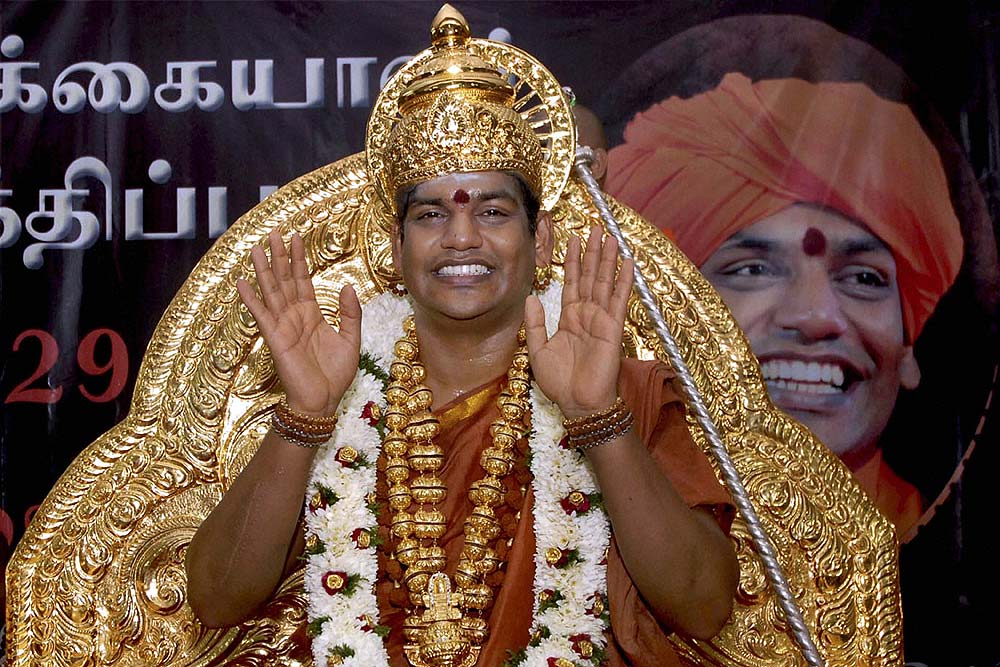
Swami Nithyananda The ‘obliging’ godmen of the modern era
After having hidden that act of sexual indiscretion, Kunti reappeared on the scene as a princess, ready to choose her husband from among numerous royal candidates, through a custom called swayamvara (which allowed the woman to embrace a spouse of her own choice from an assembly of candidates). Will the present BJP government—which claims to restore the so-called Hindu traditions—dare to re-establish the custom of swayamvara? To come back to Kunti, in the swayamvara assembly, she tied the garland of flowers around the neck of Pandu, thus announcing her choice of him as her husband. They led a happy married life, till one day Pandu, during a hunting spree, interrupted the mating of a pair of deer by shooting at them with his arrows. The deer were actually a human couple. The husband, who was the son of a sage, had decided that day to take on the form of a stag and transform his wife into a deer, to savour the delights of animal sexuality perhaps! Angered by being stopped mid-way in his adventure, the sage’s son cursed Pandu, predicting that he would die if he ever tried to make love to his wife. An anguished Pandu requested Kunti to conceive through other means, in response to which she made use of Parashara’s old blessing—and summoned, one by one, the gods Dharma, Vayu and Indra, sleeping with whom she gave birth respectively to Yudhishthira, Bhima and Arjuna. Requested further by Pandu to help his other wife Madri to conceive, Kunti summoned the twin gods Ashwini Kumars, who impregnated Madri which led to the birth of the other two Pandavas—Nakula and Sahadeva. The above accounts are from the Adi Parva, the first volume of the Mahabharata—which the Sangh parivar ideologues cannot surely dismiss as figments of a Marxist imagination! What follows in the next 17 volumes of this fantastic epic is a cornucopia of romantic stories, secret intrigues and surreptitious love affairs (with which the main narrative of battles and wars are interspersed) that unfold a variety of sexual lifestyles and inter-caste/racial liaisons (which had made possible the birth of Vidura in the past, and the later romance between Bhima and the forest-girl Hidimba, or the marriage of Arjuna with the Manipur princess Chitrangada).


Since RSS ideologues revere Mahabharata’s characters, they should permit the emulation of their liberal lifestyles.
 
 
If consenting adults in India today seek to follow a similar pluralistic lifestyle of multifaceted and multi-integrated romantic relationships cutting across caste/racial/religious lines, it invariably invites violent opprobrium from the parivar. In the rural areas, in the name of preserving the purity of the multi-tiered Hindu caste system, its ideology of ‘Indian culture and tradition’ encourages the khap panchayats to lynch any couple daring to follow the example of Bhima and Hidimba, or excommunicate a modern Vidura as ‘illegitimate’! In the urban areas of India, the same ideology encourages a xenophobic, aggressive bias against people from the non-Hindi-speaking northeast—leading to the rape of today’s Chitrangadas of Manipur in the streets of national capital Delhi.
Sangh parivar sants and BJP politicians in the role of gods of the epics: As for the heroes and heroines of Mahabharata, the ideologues of the Sangh parivar may explain away their acts of pre- and extra-marital sex, inter-caste or inter-racial relationships, as blessed and sanctioned by the gods. But since those divine progenitors of the Pandavas—Dharma, Vayu and Indra—have failed to reappear in modern times, the Sangh parivar appears to be creating their human counterparts in the shape of godmen and MPs and mlas. We thus find characters like Asaram Bapu and his son Narayan Sai from north India, and Nithyananda from south India—all close to the parivar—taking on the role of gods to seduce their female devotees with the promise of divine salvation. They are facing criminal charges in the courts. Then, there are the BJP ministers and leaders, like Nihal Chand Meghwal (Union minister of state for chemicals and fertilisers), Kri­shnamurti Bandhi (BJP MLA from Chhattisgarh) and Madhu Chavan (BJP leader from Maharashtra) among many others—who have been accused of rape. They can perhaps be seen by the followers of Sangh parivar as reincarnations of the all-mighty rishis of the past (Parashara, Durvasa and others who could always get their own way by threats or curse), and as a privileged lot like them, can pick up any female of their choice, and—because of their present political clout—can silence their victims and their families with threats of elimination.
Given this reality, the present BJP-led government and its ideologues will have to make up their mind about the Maha­bharata. Since they revere the heroes and heroines of the epic, and want to prove that they were historical characters, they should permit the common citizens to emulate the liberal lifestyle that they led. But then, what happens to the Sangh parivar’s grandiose plan of creating “a morally pure Hindu” society populated by sexually constipated men and women? In order to overcome this embarrassing dilemma, the BJP government and its RSS mentors have two options. One, in obeisance to both the female and male deities and and mortals who are described in the epic as following a rather permissive sex life, they should scrap their own programme of imposing rules and restrictions for the man-woman relationship, ignore cases of pre-marital sex or relationships between consensual partners, and stop branding inter-religious liaisons like a Muslim boy’s love affair with a Hindu girl as ‘love jehad’. The other option is banning the Mahabharata in its original version altogether—so that the public does not have access to the full text. The RSS historians can bring out, instead, sanitised editions of the epic that blot out the explicitly described stories of the promiscuity of their deities and the birth of their heroes and heroines.

(Sumanta Banerjee is a cultural historian who specialises in research into popular culture, particularly of the colonial period. He is the author of many books, including The Parlour and the Streets: Elite and Popular Culture in Nineteenth Century Calcutta.)

Wednesday, July 11, 2012

You forwarded a web article claiming that the Higgs Boson is the dancing Nataraja. Though i was taking note of the news reports on the matter for a long time since the reports came a few years back. But upto now I did not look at the net. After 6th July I was searching the net and found a number of portals claimed a religious significance to the discovery. They were mostly hindu and christian sites. I did not see any from islam. One claimed that 'god particle' was extensively dealt in our ancient scriptures like upanishads etc. where the Paramatma is mentioned. Now science is providing proof of it after thousands of years. This is the most silly idea I found there. When I opened the net there was the long article in Wikipedia. Though Wikipedia is not as scholarly as Encyclopedia Britannica or the US counterpart; it carried a short history of the developments upto 6th July. Good and informative. It did explain as to how the name 'god particle' came into it. It was a fancy name giver by a science journalist in his book. No scientist connected with research has used any such name. In fact they detest such misleading names given. the Higgs Boson is a sub atomic particle and material in every sense and connect it to anything spiritual is to be termed as cheating the people in the name of religion. Hindu Paramatma could not be perceived. If someone claim it the same cannot be verified by any other person. In the case of Higgs Boson it was perceived by all the scientists gathered there uniformly. God is not like that. People like Deepak & Co has appropriated the god in themselves and never subject the claim to verified by another. This much for the time being.

Yours Appa.

Friday, May 25, 2012

Ernesto Guevara's book "Guerrilla Warfare". Jay

Dearest Nana,

I have finally finished reading Ernesto Guevara's book "Guerrilla Warfare". Getting to know the experience of the Cuban revolution from first hand of one of its leaders is very interesting, inspiring and full of knowledge.

Apart from specifics of the Cuban experience, there are some issues that you can relate to how things are happening, for example, in Irak, Afghanistan, Siria, etc. as well as some of the moments from the past such as the Vietnam War. You can understand more in depth how the local people are trying to, and in some cases, managed to, defeat the army of the first superpower of the world, what tactics do they use, what mentality they keep and all the sacrifices they have to make in order to fight oppression.

There are also many things that relate to Sun Tzu's sayings in "The Art of War", that apply to the guerrilla lifestyle. The thing is, that Guevara, in this book, makes special emphasis on the revolution starting in the countryside, with the villagers, but the basics can apply to any situation, taking into account its specific conditions.

That is all for the moment. More on the next one.

Yours loving,

In reply to his Grandson Jay


Jay Dearest,

I have not read anything by Guevara in my past but knew about him and the Cuban revolution led by Fidel Castro. I am plucking bits from my long lost memory. I have not checked on any of these in the web as well. It is too bothersome to go thru those webs. I also think that rather than Guevara it was Mao who instilled and inspired communists here. Possibly it is the result of successful revolution in that vast country an Asian one.

In those days we were demonstrating against US attack on Cuba. We also demonstrated in support of China.
I came to know much from the book Red star over China by Edgar Snow a well known American writer. Another was a book on the long march undertaken by the Chinese Communists by Agnes Smedly. The Japanese war on China helped the party to form armed resistance from hilly rural areas towards urban. But Chiang with active support of US gained much. However it did not help and Chiang fled the main land to remote Taiwan.

In India communists here and there formed armed struggles after India attained independence. One of the earliest was in Punnapra-Vayalar in then Travancore in Kerala. Another was in Naxalbari in West Bengal. The second lasted for more time under the leadership of Charu Mujumdar and Kanu Sanyal. Finally this resistance collapsed. Mujumdar lived longer frustrated and alone. Communist party/parties changed their ideas at times and fragmented except for the CP Marxist. The once united party turned first pro Moscow and the other split being pro Chinese. They termed Chinese revolution led by peasants as the guide to third world countries where industrialization is little and therefore no dominant working class. Marxism was re-interpreted.

Take today’s situation. The rural in developed countries is too negligible to lead any movement. The middle class is not interested in changing the system. All the occupy Wall Street movement never got the momentum to achieve the results. So many protest rallies in Europe like in Greece or in Spain and many others cannot help due to apathy of the others. This is a background where extremists are trying to embark on armed revolution.
After the 2nd world war it was time for all kinds of movements to claim legitimacy claiming that they are for socialism and democracy. None f those countries like Egypt, Algeria etc in Africa. The so styled people’s democracies in Europe failed abjectly in both counts. You must have heard about Patrice Lumumba of Congo in West Africa. By the way there was/is a university named after Lumumba in Moscow catering to students of third world countries.  Belgium supported armed forces finished him off. The military dictatorship ruled for decades. I have not checked its present status.      

In India the Maoist movement is spread along the tribal belt from Naxalbari in North to Western Maharashtra chasing from Bihar, UP, Odissa, Andhra and so on. They seem to be very active in confronting the authorities in the states, abducting and killing officials. In my view they are keeping the tribal isolated from mainstream developments at the same time demanding developments to their satisfaction. There are a well knit group of sympathetic intellectuals like Ms Arundhati Roy who argue the case for Maoists. They have no answers to questions posed by others not so sympathetic or adversaries. The middle class is moving towards a better life for them under the circumstances. The peasants are not interested in anything but their lands. The poor is looking to all to help them survive. I need not say anything about the rich. So what is the future? Conflict, civil and armed? I don’t know. I am unable to envisage any future. Might be there will come people better equipped to meet the problems and find practical solutions.
One problem that may not resolve is the conflict between resources including land as against the unlimited increase in world population. China went thru a face of one child in family and today reports are coming about the aging population versus younger. So long!! 

Yours own Nana.

Wednesday, March 14, 2012

Kodungallur Bharani Festival

Today I had an idea to search for info on Kodungallur Meena Bharani in google. Now the Meenam month is starting. There appeared a long list of windows. I don't know whether you are aware of this festival. I mentioned this in my autobiography but few words. The Google sights are full of info on the strange festival. The followers sing obscene songs about the goddess. Today it seems to have more followers if we witness the photos and videos. In sights there are too many Bharani pattu matters. Since I cannot hear, I perused only those I could and see. You may try the search on the subject.

The legend about the temple is connected with the Tamil Classic work"CHILAPPADIKARAM" the story of Kannagi and Kovilan. Due to circumstances they move to Madurai the capital of Pandya kingdom. There Kovilan goes to sell one of Kannagi's anklets in market. The police took him as the thief of anklet of the queen and took him to the court. The king sentenced him to death. He was done to death. Kannagi heard about and too angry furious reached the court of the King and questioned the king to prove that the anklet that was with Kovilan was that of queen. She broke her anklet by throwing on the floor and established that anklets are different. Kannagi plucked one of her breasts and threw it onto the Madurai city that caused the city to burnt to ashes. She left the kingdom and reached Kodungallur in Kerala and stayed there. She is called Godess of single breast (otta mulachi) I had the Malayalam translation of this Tamil classic by my Sanskrit teacher P.Narayanan Nair. It was so many decades back and I have forgotten a lot of this story. During the annual festival i.e. Meena Bharani devotees chant very obscene songs and dance all the way through all villages upto the temple. Google has sites featuring these songs. You may try and locate the sites.

This is all for the present. Happy to hear about welbeing of all in location.

Yours with lots pf love Appa.

Tuesday, June 21, 2011

Daddy's opinion .

You must have noticed the happenings during last month and weeks passed. The UPA is very much affected adversely. The have reacted to the happening in manner that is not fitting to the norms of democracy. The media went crazy with half digested reports from sourses not known. The future of the UPA is in danger of collapse with so many scams featuring DMK ministers. Some time I felt that the judiciary acts/make observations that are not exactly judicious. 2G spectrum looks like the verdict is already made up. When a bench is monitoring/directing the ED, IT & CBI the lower courts will be influenced by that. When the ED presented charges against Hassan Ali on the matter of money launderng the lower court presided by Justice Tahilramani threw those papers as having no value. It was the intervention from the highest that started the long name droping exercise. I am stoping here.