Tuesday, November 03, 2015

Jon O’Brien: “The Catholic Church has an obsession with sexuality”

US-based Catholics for Choice chief criticizes the Vatican’s position on women and gays


Jon O’Brien believes that the Catholic Church’s hierarchy is drawing further away from its followers and social reality – above all when it comes to sexual and reproductive rights.
The 50-year-old Irish Catholic, who is president of the US organizationCatholics for Choice, believes in a secular state, and has severely criticized the Vatican for its treatment of women andhomosexuals.
Question. Do you think Catholic Church officials are successfully taking on the challenge of adapting to the diversity of their believers in today’s society?
Answer. There was a great theologian who once said: “Catholicism is defined by unity and diversity.” In other words, this is not a monolithic Church. When I go to Mass on Sunday and I look around me, I see over there two gay men who’ve been in a relationship for a long time. Over on my right hand side I see two gay women who’ve adopted a child. There is also a couple who have divorced and been remarried. All of us are using birth-control methods, and many women have had abortions. This is the reality of the Catholic Church today. The Church is not a building somewhere in Rome; it’s not a building in Madrid. The Church is all of the people and the people as we are manifesting ourselves today have a very different sexual aspect than what the hierarchy has emphasized.
Q. Do its doctrines correspond to reality?
A. It seemed as though the last two papacies, John Paul II and Pope Benedict, were very focused on the pelvic zone, very focused on our genitalia, and very focused on adherence to a rule. No matter where you go, if you ask Catholics what they believe, if you ask Catholics what they do, it’s very different than what they do in the hierarchy. I think that’s the reality of the Church. My biggest problem is that they have failed us as Catholics to follow them. And they do not represent, I would argue, we Catholic people – they represent themselves. The Bishops now go to Congress in the United States, they go to the UN, and they go to the government in Spain, and they try to convince them to turn their theology into law that doesn’t represent us.
Q. Has the Catholic hierarchy grown further from the flock?
A. I think they are representing a failed way of thinking. There are various reasons why the Catholic hierarchy ended up with many failures in sexual ethics. Sometimes it was good intention that they wanted to be closer to God, so the idea was that those who are celibate are closer to God. They had, I think, good intentions. But the road to hell is paved with good intentions. I think that reality today is that if you stop women from having access to safe abortions, they would have unsafe abortions. And if you stop people from gaining access to contraceptives, they can’t avoid an unplanned pregnancy. These are the realities: the reality is that marriages break down, the reality is that people are gay that are Catholic. So we have to deal with the real world. The real world tells us that there’s something that has very much failed the bishops’ view, and certainly the bishops are entitled to hold their view.
Q. Despite the social advances and more voices like yours among the flock that are speaking out, the Catholic Church has not changed its position on abortion, birth control or homosexuality.
A. I think that most Catholics have moved on in our ordinary lives. I still go to Mass on Sunday, so do women who have had abortions and used contraceptives. We don’t feel guilty, we know that as good Catholics we can make a decision based on our conscience because this is not just about feeling good. At the very center of Catholic teaching is that not only should you follow your conscience, but you “must” actually follow your conscience. And I think that the people who use contraceptives, the people who have abortions, people who are gay and lesbian, are following their conscience. It’s between them and God.
Q. What should be the relationship between Church and State?
A. Maybe our bishops in Spain and Portugal and Ireland should stop going to politicians and saying that this is the law I want you to enact. It’s inappropriate. Religious actors can have their view but I think that a truly secular state – and that I believe the secular state is not anti-religion – is neutral and balanced. I think it gives great protection to religious people because I don’t get someone else’s religion being imposed upon me as a Catholic and I don’t get to impose my religion on other people of a different faith or on non-believers. I think that those are the type of laws that are most just and most fair.
Q. Do you believe the Catholic hierarchy has intervened too much in politics of state?
A. Yes, I think there’s no doubt about it. These men go on to lobby politicians to turn their beliefs into law when they don’t even have Catholic followers. You see this around the world, you see it time and time again – the fight against gay marriage, the fight against the legal right to abortion. If you look at Poland, if you look at Spain, if you look at Ireland, the fight against the equal rights of citizens sadly is very often led like hierarchy in my Church. And I think that’s why Catholics really have to do something, though it is not easy. If you see someone doing something wrong you have to say something. And I think we see the hierarchy in our Church doing different things – trying to pressure politicians to legislate for themselves – and I think we have to stand up and say that this is the wrong way for the hierarchy and the Church to behave. And tell people that when they speak, they don’t speak for all of us.
Q. Some people have described Pope Francis as too political.
A. I think that there is a part of this pope that is very genuine. I think he really is genuinely trying to be more pastoral than political as to when other popes were trying to get the government to do this, do that. I think he cares about the human condition. I think that is a really welcoming thing because we too often have had a political Catholic Church and not a pastoral Church. I am not trying to say that he agrees with me on these things but he is being much more loving and caring, and not lecturing as much as his predecessors. The pope is Argentinean but I don’t think he is a Che Guevara – he is not Che Guevara, but maybe more like Gorbachev when he had something to say.
Q. Has he opened a channel of communication and changes in the Church?
A. He presented the idea that people should be able to have a conversation about what type of society they want. Who knows whether the bishops under Pope Francis will be braver and if they will actually admit that there are many things in our Church that are unfair and unjust. One of them being the way that women are treated in the Church. They are not treated with the real respect and dignity that comes with women being equal to men.
Q. Do you think gender inequality is one of the major problems in the Church?
A. The idea that you have a corporation, for example Apple, saying tomorrow, we’re not going to have any woman in senior management. It would be crazy for a business to do that or for any other institution. I think it’s crazy for the Church, too. We exclude women at the cost of the Church not being as smart as it could be and should be. So I think when the bishops meet together [they should discuss] maybe the issues of women, about women’s health, women’s lives, women’s meaningful position within the Church – a position that is rightfully theirs and which is half of the church.
Q. What do you think about a priest coming out in public as gay and at the same time admitting to having a boyfriend?
A. One of the worst-kept secrets in the Catholic Church is that a lot of the clergy are gay. Certainly, I would welcome a more enlightened view of gay people in my Church, but we, the Catholic faithful, would also welcome more truth about divorce and remarriage, about women who have abortions, and about couples that use contraceptives. There are a myriad of issues queuing up to be addressed. With its failure to talk about the real world, the Catholic hierarchy’s sins of omission extend way beyond a gay priest in the Vatican who could no longer live in hypocrisy and lies. The list goes to the very heart of Catholic teaching on issues connected with the pelvic zone. We need a complete overhaul if social justice is to be done – not just gay priests talking about gay priests.

Article from "El Pais" IN ENGLISH
  • Enviar a LinkedIn0

Thursday, October 29, 2015

"INSIDE OUT" Pixar Animation Released by Walt Disney Pictures


As said by my son Ravi self watched the movie "Inside Out" , an American 3D computer animated comedy-drama adventure film produced by " Pixar" Animation studios and released by Walt Disney Pictures.

The film is set in the mind of a young girl, Riley Andersen where five personified emotions -  Joy, Sadness, Fear, Anger and Disgust try to lead her through life as she moves with her parents to a new city.

After premiering at the 68th Cannes Film Festival in May, Inside Out was released on June 19th, 2015. As a child director Pete Docter relocated with his family to Denmark when his father moved to study the music of Carl Nielsen. While his sisters had an easy time adjusting to the new surroundings. Docter felt he was judged constantly by peers. While other kids were interested in sports, docter sat alone drawing, a hobby that eventually led him to animation. His social anxiety ended by high school.

In late 2009, Docter noticed his pre-teen daughter, Elie, exhibiting similar shyness. She started getting more quiet and reserved, and that, frankly, triggered a lot of my own insecurities and fears, he said. He imagined what happens in the human mind when emotion set in. The idea to depict it through animation excited Docter, who felt it the ideal form to portray "strong" opinionated, caricatured personalities. He began researching information about the mind. Docter found surprise and fear to be too similar, which left him with five emotions to build charecters around. Keltner (A Professor of Psychology at the University of California, Berkeley) focused on sadness being an emotion that strengthens relationships.

The choice to focus the film as a girl come from research that claimed that females age 11 to 17 are more attuned to expressions and emotions than others. The idea to have Riley play hockey came from "Del Carmen", who noted that the sport is big in "Minnesota" ( is the second northern most  U.S. State after Alaska) (Midwestern United States).

"Kevin Nolting", editor of the film, estimated there were seven versions 0f "Inside Out" created before it even went into production.


"Docter" feels the emotions are meant to connect people together and that relationships are the most important things in life. He decided to replace fear with sadness, which he felt crucial to renewal. "John Lasseter" calls "Inside Out" cast "One of the most talented" in "Pixar history".

Thursday, October 22, 2015

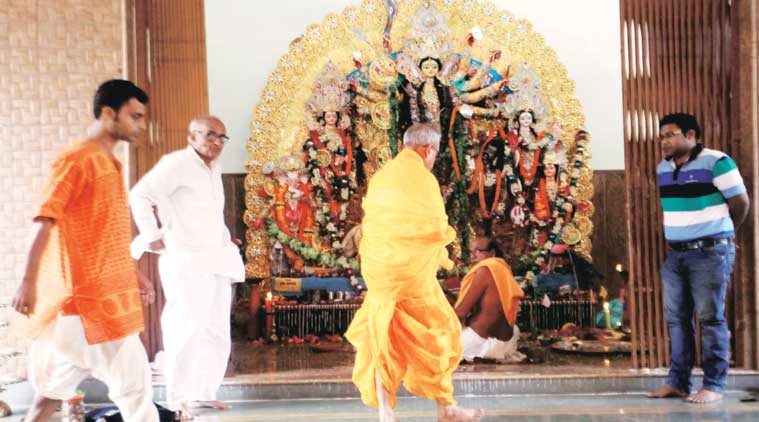
Look at idol of Goddess Durga, many identities co-exist: President Pranab Mukherjee

This combination of “asangatir shakti” (disparate forces), he said, “means that society has to admit to itself the reality of living together.”


Written by Aniruddha Ghosal | Mirati (birbhum) | Updated: October 22, 2015 9:28 am
pranab mukherjee, Pranab Mukherjee, Pranab Mukherjee Durga Puja, Pranab Mukherjee celebrates Durga Puja, ink attack, beef, beef ban, beef row, president, tolerance, intolerance, latest news
AdTech Ad
President Pranab Mukherjee at his home in Birbhum Wednesday. (Express Photo by: Subham Dutta)
Using the metaphor of the carriers of Goddess Durga and her children, President Pranab Mukherjee once again underlined Wednesday the need for tolerance in the country saying “different, seemingly disparate forces can be seen co-existing” in the idols.
Speaking on the eve of Vijaya Dashami from his ancestral home at Mirati in Birbhum, Mukherjee said: “The main thing is tolerance, to try and understand each other and preserve different identities of each other… We can see that in the idol of Goddess Durga, different, seemingly disparate forces can be seen co-existing.”
“Shiva’s vahan is the bull, but the bull is also a source of food for the lion which is Durga’s vahan. The rat and the snake have no relationship of friendship. But the rat is the vahan of Ganesh while the snake is one of the weapons that Durga carries. The peacock and snake have a relationship of animosity, but the peacock is Kartikeya’s vahan.”
SHARE THIS ARTICLE
Share
RELATED ARTICLE
This combination of “asangatir shakti” (disparate forces), he said, “means that society has to admit to itself the reality of living together.”
“Opposing forces, different opinions… co-existence of these increase ties within society and increase society’s capacity to move forward… We must maintain social harmony and must respect and promote tolerance and co-existence. This has happened through the years and that is why India has survived for so long.”
The President said Durga Puja was not just a “religious festival” but also a “social festival”.
“It is no more a religious festival… it becomes a social festival, resulting in universal participation from a cross-section of society. This is also an opportunity for me to meet so many different people,” he said.
Two days ago, the President, while referring to growing incidents of intolerance, expressed the “apprehension whether tolerance and acceptance of dissent are on the wane” in the country.
Underlining that “humanism and pluralism should not be abandoned under any circumstance”, he said he hoped that “Mahamaya, the combination of all positive forces, would eliminate the Asuras or divisive forces”.

Wednesday, October 21, 2015

‘Siesta,’ ‘fiesta’ and 17 other Spanish words that ‘guiris’* use

‘Siesta,’ ‘fiesta’ and 17 other Spanish words that ‘guiris’* use

A look at some of the terms from Spain that have become lingua franca over the centuries

  • Enviar a LinkedIn25
  • Enviar a Google +44
  • Comentarios1
AMPLIAR FOTO
“Siesta: That pleasure of resting or sleeping for a few minutes after lunch.”
Most Spaniards probably think their language has a trade imbalance, importing more words than it exports, but that hasn’t always been the case. The accidental arrival of Columbus in the Americas and the Golden Age of the arts that followed saw Spanish words travel around the world, taking root throughout Europe. In those days, Spain’s was a dominant culture, setting trends.
For example, the fact that Spanish words such as armada andchocolate are found in languages such as English, Hungarian and German is a reflection of two types of natural language processes. Alberto Bustos, a linguist and author of a Spanish-language blog called Blog de Lengua, explains that “anybody who invents something, invents the word that describes it” and also that “language can help a culture adapt to realities that are foreign to it.”
If the smartphone is conceived in an English-speaking area, that’s the term most of the planet will use
What’s more, says Bustos, Latin is one of the main reasons that different languages share expressions we think are our own. “In this case it wouldn’t so much be a Spanish contribution, as much as a derivation or appropriation of Latin terms.” If you have ever come across an international publication referring to a president’s agenda or the calling of a referendum, that’s why.
“When two languages come into contact,” says the expert, “they tend to influence each other, but the exchange isn’t on the same terms.” Other factors come into play, such as culture, economics, and politics. That explains why English is the language that today “lends” more words to others, and Spanish can barely manage a few now and then. If the smartphone is conceived and advertised in an English-speaking area, that’s the term that most of the planet is going to use. Similarly, if Spain is known around the world for the variety of its cuisine or its traditional culture, it should come as no surprise that words related to these travel abroad and are picked up by foreigners. Geographic proximity, migration and tourism will do the rest.
These foreign words that retain their original spelling are known as loanwords. Below is a selection that Spanish has contributed to the English lexicon.
‘Corralito’ originally referred to a public playground that has been closed off to stop children from escaping
1. Corralito. This is when a government decides to close the banks and prevent people from withdrawing money – as is currently happening in Greece. The word was first coined in 2001 in Argentina by journalist Antonio Laje to describe the country’s financial crisis. The noun’s original meaning refers to a public playground that has been closed off to stop children from escaping. In turn, it comes from ‘corral,’ a Spanish word that entered English via the United States, as a pen or enclosure for animals.
2. Mosquito. The insect that kills more people around the world than any other. In Spanish it means “little fly.” National Geographictells us that its activity increases five-hundredfold during the lunar phase.
3. Guerrilla. Che Guevara was arguably the best-known exponent of this military strategy, which in Spanish means “little war.” The idea is that small, dispersed groups attack and harass the enemy. The word entered the language during the Peninsular War against Napoleon. The success of the campaign against the French led to the term being applied to fighters, as well as the form of combat itself.
4. Macho. The qualities traditionally associated with masculinity. The term was famously used by US disco group Village People on their hit record Macho Man.
Leaving siestas and fiestas aside, ‘tapas’ has arguably most come to identify Spain in the minds (and stomachs) of foreigners
5. Daiquiri. A cocktail made with lemon juice, white rum and sugar. The name comes from a neighborhood in the Cuban town of El Caney where a US-owned iron mine was located. Visiting Americans picked up on the delicious drink, making it world famous.
6. Peón. This Spanish word is used in English and other languages to refer to a day laborer. To a lesser extent, it is also used to describe low-ranking infantry soldiers. It originally comes from the Latin word pedo, which has nothing to do with the modern Spanish significance of the term, which means ‘fart.’
7. Siesta. Spain is still sometimes disparagingly referred to as the land of the afternoon nap, but the tradition is also popular in many other countries. Winston Churchill adopted the habit after visiting Cuba during the country’s fight for independence from Spain.
8. Cafetería. Used throughout the world to describe anything from a coffee room to a restaurant, and now, of course, also a place to find a free WiFi connection.
9. Fiesta. That magical moment when a group of friends gets together to celebrate. The reasons can be many and varied. Foreigners love to say the word, and like siesta, it has become inextricably linked to Spain, thanks in large part to fiestas such asSan Fermín and the Tomatina in Buñol.

about verne

In past times, explorers, adventurers and writers scoured the Earth seeking out the wonders of the world. Today, we have the internet. VERNE: a thousand marvels a minute. Click here for more verne stories in English, and here for the Spanish page.
10. Cilantro. A sweet-smelling herb used in cooking, which supposedly also has medicinal properties. In some English-speaking countries it is also known as coriander, but in the United States particularly, cilantro is what you want in your guacamole, for example.
11. Embargo. Rooted in Latin, this term refers to ban on trade with another country. The United States has famously imposed one on Cuba for more than half a century.
12. Aficionado. An expert in or exponent of a sport or art form. Ernest Hemingway was a great bullfighting aficionado, for example.
13. Adobe. One of the many words to enter Spanish from Arabic, it refers to a crude mud and straw mix used to make bricks, and has long been a commonly used building material in Latin America. Today it may be more familiar as a brand of software, and was apparently chosen because one of the founders of the company lived near a place in California called Adobe.
14. Loco. All languages have their word to describe somebody or something that is mad or crazy, but this Spanish word has captured people’s imaginations around the world. Spain even has its mad queen, Juana la Loca. Argentinean soccer coach Marcelo Bielsa was dubbed “El Loco,” and there is also a town in Oklahoma of the same name.
15. El Dorado. Countless Spanish explorers disappeared while searching for the legendary city of gold hidden in the jungles of South America, among them Francisco de Orellana, who in the process became the first European to navigate the Amazon river. Several centuries later, Indiana Jones set off in pursuit of it, while Cadillac decided it was a great name for a car. As the place was never found, the term often has negative connotations.
16. Patio. In Spanish it means courtyard, while in English it has come to denote a small, paved garden, typical of suburban houses.Game of Thrones character Jaime Lannister was recently seen in the legendary Patio of the Maidens in Seville’s Alcázar palace.
17. Bodega. Originally a place where wine was stored, the term has also come to refer to mom-and-pop stores, particularly in the southwestern United States, as a result of the area’s proximity to Spanish-speaking countries and large migrant population.
18. Tapas. Leaving siestas and fiestas aside, this word has arguably most come to identify Spain in the minds (and stomachs) of foreigners. The origin is disputed, with some linguists saying it comes from the practice of serving a drink with a piece of bread or plate on top of it to cover, or tapar, the glass. Granada’s bars have established a reputation as being among Spain’s most generous in providing tapas with their drinks.
19. Matador. The romantic, or macho Spanish male par excellence, and a figure that has long captured the imagination of foreigners. Ernest Hemingway, that bullfighting aficionado, immortalized two of Spain’s best-known matadors, Luis Miguel Dominguín and Antonio Ordóñez, in his posthumously published book The Dangerous Summer.
* If you don’t know what the word ‘guiri’ means, chances are you are one...

Friday, August 14, 2015

Independence in the Mirror                                                                            


68 long years! And it is not such a small time in the life of a nation that one should not assess and introspect. Almost three generations have grown during this time and they should be made to respond and account for what they have done or not done at the personal as well as social and national level.
Even at the risk of being dubbed a cynic and a madman I feel like stopping people at the crossroads and asking whether during all these 68 years we have grown more hard-working, more honest, more sincere, more cordial to our fellow beings, more tolerant of others’ views as individuals and as social groups, more loving and caring to our employees and subordinates, more transparent as a business man, as an administrator, as a politician, more loving, caring and responsible as a parent, more duty conscious as a citizen, more equal before the law etc. etc. But who would bother to stop and answer sincerely any of my questions?
I really pity what we have done to ourselves during these precious 68 years. We have failed to provide pure and unadulterated water and drinks, food and vegetables and other eatables to our children and families. Our products in the industry are sub-standard and sometimes not even fit for human use and consumption. We are not sure of the quality of the medicines and even less sure that the medical prescription handed out to us and our family is really genuine and needed. The education we give our children at such exorbitant cost fails to make them even a tolerably responsible citizen and a creative and positive member of the family and society.
We had struggled and fought the foreign rule for our freedom. But I feel like asking which freedom had we fought for and what we have received in return. Let us see the mirror and tell honestly what we see therein. Is there less corruption now than it was before 1947? Are we more truthful, honest and sincere as employees than we were before 1947? Have we developed a national vision as teachers, doctors, engineers and other fields of professions? Have we become more rational, knowledgeable and logical than what we had been before 1947? Are we today more free from superstition, blind-faith and rituals than we were before 1947? Have we developed any better spiritual vision of life than we had before 1947?
Of course my contention is not that we were better during the slavery but we need to pause and think where and why we have gone wrong. Why has the freedom not given us what we all had expected? Why even after these 68 years, irrespective of our castes and genders, religion and faith, we are not equal before the law of the land?
Do we wish to find answers in the speeches of our leaders and discussions of the arm-chair intellectuals? If so, we are being evasive and may find ourselves more degraded and degenerated during the next 68 years. Solutions, if tried, will be found only in actions and on the streets, in the offices and on the floors of industry.
 Very sadly I am reminded of what Winston Churchill had said about our freedom. He had boasted that the British had ruled over India for more than 200 years and that too from a foreign land, but Indians would not be able to run their own country, with their own government and people, even for one hundred years. How painful, yet true seems to be the statement!
Is it not time to stop and start doing? Let us stop the blaming game, let us stop passing the buck and let us stop waiting for the government to take initiative. Let each one of us pledge to work in our own way for the nation in whatever little or big manner we can. Therein alone lies the key to our progress – individual, social and national.


 Ved Guliani


Essay
The Body Impolitic
She may be all body. But the raw female is to be invisible.


I was struggling into my bra when Saba called on my cellphone. I had a choice: I could take that call and fasten my bra later. Or—and that’s the choice I did make—I could fasten the obstinate clasp, feel more secure, and call her back. These seemingly inconsequential, small but significant choices a woman makes every waking hour define the quality of her life far more significantly than all the other, more ‘important’, much ‘bigger’ issues. It wasn’t just about the bra, of course. I was running a little late for an important appointment and couldn’t find the right footwear...it had been ‘bor­rowed’ by a daughter. I should have iro­ned the new jacket from the flea market, but hadn’t. It was hanging like a limp, shapeless shroud around my shoulders. My mind ought to have been sharply foc­used on the content of the lecture I was to deliver half an hour later. But it was making sure I didn’t forget to throw my cellphone into the over-stuffed tote...ohh, and the reading glasses! As usual, I had to rush back from the elevator to locate them—come on, come on, come on.... I had been scanning the headlines moments ago...where the hell was the bloody chashma? I retrieved it from under the wet towel I’d carelessly thrown on an unmade bed (damn!), I’d also forgotten to switch off the fan. Both lapses are seen as cardinal sins in my husband’s book. When I finally  got into the car and called the organisers to say I was running 10 minutes late, making the standard Mumbai monsoon excuse everybody understands and accepts (“hideous traffic, flooded streets”), my slightly flustered words were met with an embarra­ssed interruption as a young man stuttered, “It’s perfectly okay, ma’am...you see, your lecture is scheduled for tomorrow.” Oh heavens! I really could have taken Saba’s call and forgotten all about the bra.
Most women go through life severely sleep-deprived, especially if they’ve rai­sed children. Most are mildly, even sev­e­rely malnourished, sometimes without­­ rea­lising it. Most neglect their own med­ical issues, big ones and small ones. Most refuse to acknowledge that they are ever tired, bone-tired. Most postpone key personal decisions if they feel those clash with family interests. Most spend their entire adult lives feeling guilty about something or the other. Most suppress their true selves, so afraid are they of rej­ection. Most play-act, especially with their sexual partners. Most suffer from low self-worth, no matter how successful the world thinks they are. They do all of this hiding behind invisible screens.
The big picture involving women’s position/rights is a very familiar one. It takes care of itself or not—clumsily, or otherwise. But the world carries on. Women spend their lives ‘managing’ something or the other—rarely ‘living’. Rarely thinking about their own potential. Rarely making a decision that is exclusively theirs (“She’s so selfish. She’s so heartless! She only thinks of herself...”). Is there something wrong with ‘herself’?

Illustration by Saahil


Women are never really, really naked, even when they don’t have a stitch on. Women in all cultures in fact live in purdah.
 
 
It is the smallest, most intimate mom­e­nts of a woman’s dom­estic life that tell the real story. Look closely at any woman. Your mother, for starters. She’s the one woman whose ‘lit­tle things’ you will have the best access to. When you study her little things, and you put those tiny pieces together, then perhaps you will see the woman in totality. Women are pretty adept at scrupulously concealing their ‘little things’, afraid their secrets may reveal too much about their minds and hearts. Women are never really, really naked, even when they don’t have a stitch on. They also don’t like their own nakedness too much. And are convinced they’d be cruelly mocked if caught minus a cover, at least over their modesty. We are too embarrassed to say we need to pee when we do! Or defecate. Or defoliate....
What they indulge in when they think no one’s looking is significantly different from the public persona the world obser­ves, judges. Everything about a woman changes when she believes she is alone and unobserved, even her breathing patt­ern. Her body language alters when nob­ody is around...and she automatically relaxes her thighs. If you ever walk in on a woman who is one hundred per cent sure she is not being watched, notice the position of her legs. Generally, her knees will be apart, letting in fresh air to the one area of her body that rarely receives any. A woman’s conditioning is such (“keep your legs together, put your legs down, cover your knees...”). Little girls of two and three are taught this mantra and made acutely aware that something very precious lies between their legs. Some­thing they have to fiercely guard and protect. Nobody bothers to explain to them what that ‘precious’ thing really is and why they must protect it. Often they are warned it is dirty and dangerous to even think about ‘that part’. There is an unspoken threat...an unstated menace...and for the rest of their lives, women feel unsure about their sexuality and its power over them. There are times when I feel like screaming, “See! See! See! What do you want to see? Breasts? Legs? My most private self? Shoulders? Butt­ocks? Dekh lo! And then leave me alone.”
Ideally, women are expected to lead inv­isible lives...born invisible...die invisible. Our laughter is invisible. So are our tears. Our struggles are invisible—unless they are big ones, but even those become invisible after a point. What isn’t invisible about our lives? Invisible stress. Invisible grief. Invisible joys. Women spend their lives ‘managing’ something or the other—rarely ‘living’. Rarely thinking about their own potential. Rarely making a decision that is exclusively theirs. Our smallest triumphs have to stay invisible.
Menstruation was the biggest ‘invisible’. When I was growing up, it was never to be discussed. There was such shame surrounding ‘that time’ of the month, even the smallest giveaway (a tiny stain on the school uniform, a  packet of sanitary  towels lying around) was made into a disgraceful incident. An incident that left countless little girls scarred for life. The appearance of budding breasts used to cause alarm in families (“Oh God! Already! But you aren’t even 11 yet...”) as if it was all the little girl’s fault. As if she had somehow shamed her family by maturing early. As if she was a potential threat to the family’s honour.
Women in all cultures live in purdah, whether it exists physically or not. It is the invisible purdah that is much harder to leave behind. It requires a greater level of subterfuge and stealth.
To get back to the obstinate bra I star­ted out with—women can’t have their undergarments strewn carelessly in full sight of others. Bras, panties have to be kept hidden from view. Even our undergarments have to be invisible for society to feel less uncomfortable. With almost all aspects of our inner and outer lives shielded from public gaze, I do wonder what will happen to the world if we decided one fine day to reveal ourselves in all our abundant glory? Shall we?